Wednesday, December 21, 2011

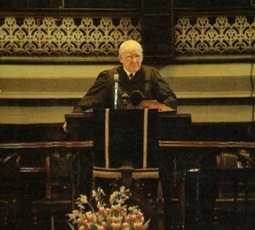
Aspiring Preachers Listen Up

The Doctor has some wise words:
Lastly, and only lastly, Homiletics. This to me is almost an abomination. There are books bearing such titles as The Craft of Sermon Construction, and The Craft of Sermon Illustration. That is, to me, prostitution. Homiletics just comes in, but no more.
What about preaching as such, the act of preaching of which I have spoken? There is only one thing to say about this; it cannot be taught. That is impossible. Preachers are born not made. This is an absolute. You will never teach a man to be a preacher if he is not already one. All your books such as The A.B.C. of Preaching, or Preaching Made Easy should be thrown into the fire as soon as possible. But if a man is born a preacher you can help him a little-but not much. He can perhaps be improved a little here and there.
How can that be done? Here I am probably going to be somewhat controversial. I would say: Not in a sermon class, not by having a student preach a sermon to other students who then proceed to criticise matter and manner. I would prohibit that. Why? Because the sermon in such circumstances is being preached with a wrong object in view; and the people who are listening to it are listening in a wrong way. The message of the Bible should never be listened to in that way. It is always the Word of God, and no one should ever listen to it except in a spirit of reverence and godly expectation of receiving a message.
When you come to further modern refinements of that such as television video-tapes so that a man may subsequently see his own gestures and so on-this to me is reprehensible in the extreme. The same applies to instruction in 'pulpit deportment' as it is called, or 'television  deportment'. There is only one word for all this; it is sheer prostitution, it is instruction in the art of the prostitute. The preachers must always be natural and un-self conscious; and if in your training  you tend to make him become self-conscious of his hands, or what he does with his head, or anything else, you are doing him great harm. It should not be done, it should be prohibited! You cannot teach a preacher in these ways; and I feel that to attempt to do so is an injustice to the Word of God.
What then should the young preacher do? Let him listen to other preachers, the best and most experienced. He will learn a lot from them, negatively and positively. He will learn what not to do, and learn a great deal of what he should do. Listen to preachers! Also read sermons. But make sure they were published before 1900!*
Soli Deo Gloria!

For His Glory,
Fernando


*D. Martyn Lloyd-Jones, Preaching and Preachers (Gran Rapids, MI: Zondervan Publishing, 1972), 118-120

Tuesday, December 20, 2011

Weekly Dose Of Lloyd-Jones

 I suspect that it is the failure of evangelical people, particularly during the last sixty to seventy years, to take seriously the biblical teaching concerning the nature of the Church, that accounts for most of the problems that we are confronting at the present time. For some reason or another, our immediate fathers and grandfathers felt that it was sufficient to form movements and they did not think in terms of the Church, with the result that evangelical witness is diluted among the great denominations and evangelical Christian people only meet together in movements instead of in Churches. So from that standpoint this is a highly important subject. If we have a deep concern about the evangelical message and its vital importance in the world today, then we are compelled to consider the doctrine of the Church.
Now as we approach the biblical teaching concerning the nature of the Church, let me also make my usual introductory remark. This is a highly controversial subject—practically all of the doctrines have been so, have they not? But history alone assures us that this is perhaps the most controversial of all. And yet it is sheer cowardice to avoid dealing with a subject simply because it is controversial. Whatever our upbringing or background, whatever our prejudices, we must endeavour to consider, with as open a mind as possible, what the Scriptures have to tell us. Let us all try to do that, praying that God will deliver us from the prejudices from which we all tend to suffer.*
Soli Deo Gloria!

For His Glory,
Fernando


 *Lloyd-Jones, D. M. (1998). The church and the last things (3). Wheaton, Ill.: Crossway Books.

Sunday, December 18, 2011

A Prime Example Of What Is Wrong With Contemporary Christian Music


You might be the wife waiting up at nightYou might be the man struggling to provideFeeling like it's hopeless
Maybe you're the son who chose a broken roadMaybe you're the girl thinking you'll end up alonePraying "God, can you hear me?Oh God, are you listening?"
Am I more than flesh and bone?Am I really something beautiful?Yeah, I wanna believe, I wanna believe thatI'm not just some wandering soulThat you don't see and you don't knowYeah, I wanna believe,Jesus, help me believe thatI am someone worth dying for
I know you've heard the truth that God has set you freeBut you think you're the one that grace could never reachSo you just keep askin', oh, what everybody's askin'
Am I more than flesh and bone?Am I really something beautiful?Yeah, I wanna believe, I wanna believe thatI'm not just some wandering soulThat you don't see and you don't knowYeah, I wanna believe,Jesus, help me believe thatI am someone worth dying for
I don't usually listen to Christian radio stations (or any radio stations for that matter). Though, my mother enjoys some of the music (she isn't reformed). We often have dialogues on the theology of some of the songs. As the radio was playing, I came across the song above, and I couldn't believe what I heard (not kidding): A song that asks God to help the person believe that they are "someone worth dying for". Wow, really? Here I thought that I was totally unworthy of the death of my savior! I thought that grace, this saving grace, was totally unmerited. That there was nothing in me to cause God to love me, and save me. But, I guess I was wrong? Jesus died on the cross for me...because I am worth it? That God would be moved due to some innate worth held by a sinner?! Perish the thought.Christ didn't die for us because we are worth it. He died for us to reconcile us to the Father, because the Triune God is worth it! In Christianity, one does not look to one self as the reason  for God's love. God loves us freely. God loves us because He chooses to. The eyes should be taken off one self, and placed on Christ, as the reason for everything.

-
awretchsaved

Note: Not all of CCM is bad. There are some good contemporary Christian songs out there...somewhere. 

Saturday, December 17, 2011

Doug Wilson Nails It


Since my last two articles on alcohol this is exactly what I've been dealing with. So without further ado here are some extremely helpful words from Doug Wilson:
The Bible is a discomfiting book, for lots of people. It often says and teaches things we would rather not hear about, and represents God in ways that are disconcerting to those who would like to be known for their piety. But because man is devious, and has sought out many devices (Ecc. 7:29), we have developed various ways to work around this problem that the Bible creates. In theological circles, the ways of getting around what the Scriptures actually teach can be reduced to two broad categories—the liberal and the conservative approach.
The liberal approach rejects the practical authority of Scripture, but is oftentimes more to be trusted with what the text of Scripture actually says than the conservative approach is. This is true even though the conservatives are the ones who stoutly profess that the “Bible is the inerrant Word of God, without error in all that it affirms.” The reason is because the liberal approach is not actually stuck with having to live with the results of the exegesis. Liberalism is the way of rejection, reserving the right to say that while the Bible may teach thus and such, “we have all grown past that now.” This is why the liberal can acknowledge that the Bible teaches a particular doctrine, or sets before us a particular example, and then go on to say, “Wasn’t that quaint? ho, ho, ho.”
 The conservative, on the other hand, has to live with what he claims the Bible says. If he doesn’t want to live with it, if it conflicts with his traditions or most deeply cherished beliefs, then he has to make sure that his interpretation comes out in an acceptable fashion. Unlike the liberal, he does not have the option of acknowledging that Jesus drank wine, “but that He would have come to a more suitable position had His life not ended so tragically and so soon.”
 Thus it is ironic that many conservatives, who stand for the infallible authority of Scripture on every topic it addresses, are simply unwilling for the Bible to be okay with an amber bottle of Glenfiddich in a godly man’s cabinet. But the Bible is okay with it (Dt. 14:26), and my chances of getting a liberal exegete to tell me what the text actually says on this point are better than getting a tee-totaling conservative to do so.
 Ironically, many conservatives sheepishly acknowledge that the Bible does not prohibit the drinking of alcohol (quite the opposite), but go on to say that for the sake of a “good testimony” we should still swear off the stuff. Apart from the problems created by trying to have a better testimony than the Bible has, there is also the difficulty caused by the fact that tee-totalism provides its very own kind of bad testimony (emphasis mine).*
This is from Wilson's foreword to Joel McDurmon's book What Would Jesus Drink? A Spirit Filled Study. It is a very short book (145 pages). It is quite expensive for a hardcover copy and cheaper for the Kindle version. It is quite worth the read. It gives a great theological and exegetical presentation for the positive view of the proper consumption of alcohol. It also warns of the abuses and dangers of it and deals masterfully with the proof texts presented by prohibitionists.

When one side cannot answer for passages presented to them but only present their misunderstandings of their own, it is quite revealing of a position. McDurmon presents biblical proof that alcohol is a blessing from the Lord while answering the objections, from Scripture, of it's opponents.

Soli Deo Gloria!

For His Glory,
Fernando


*McDurmon, Joel; Wilson, Douglas (2011-08-19). What Would Jesus Drink? A Spirit Filled Study (Kindle Locations 91-1115). Tolle Lege Press. Kindle Edition.

Friday, December 16, 2011

Responding To Back Door Prohibitionists

It seems that whenever a Christian advocates the consumption of alcohol there are quite a few objections. One of them is to deny that God blessed wine and strong drink for more than water purification purposes. The other is to, in a round about way, make and advocate or consumer of alcohol feel guilty for using their "liberty" and partaking of it because it is okay to do so but not "beneficial." Along with that kind of reasoning is to hammer on the abuses of alcohol and drunkenness.

To answer some of these objections I will defer to Joel McDurmon:
There is only so much alcohol an individual can consume before enjoyment cedes to inebriation, and then sickness. One can die from alcohol poisoning. On top of this natural limit, God has decreed an ethical limit. Indulging oneself to the point of such inebriation—we commonly call it “drunkenness”—is an infraction of God’s right way of living. Thus, drunkenness trespasses both kinds of boundaries—it defies God in both His created order and His revealed Word.
 It should go without saying in any Christian discussion of the use of alcohol—at least, any discussion that honors Scripture as God’s Word—that drunkenness, excess, or abuse of wine is detestable to God and clearly a sin. Whether on the conservative side of the Christian spectrum (like me) or on the more liberal side—heck, even liberals who deny the inspiration and truth of Scripture—all parties would acknowledge that the Bible forbids and condemns drunkenness. Liberals would probably be more likely to make mainly social and pragmatic arguments against it, however, whereas some fearful and misguided believers like to extend God’s condemnation of abuse into a blanket prohibition on use.*
Many Christians take what appears to be a compromising position on the subject of alcohol. Acknowledging the Bible’s clear position on the subject, they refuse to take the ridiculous line of forbidding all alcohol. Good so far. But then, caving under who knows what social and/or religious pressures—and there are many—they then argue that Christians should voluntary abstain from alcohol. This devious moral swindle is the back door to prohibition. While not formally forbidding alcohol, it practically forbids it. Under the guise of freedom they forbid. Giving permission, they prohibit. This view pays little more than lip service to God’s revealed will, but has little intention of growing to maturity in it.
These backdoor prohibitionists remind us that Paul said “‘All things are lawful for me,’ but not all things are helpful. ‘All things are lawful for me,’ but I will not be enslaved by anything” (1 Cor. 6:12). By this reference we are expected to make the analogy: “Drinking alcohol is lawful, but not helpful. It is lawful, but I will not be enslaved by it.” In order to enforce this application, they will then pour out streams of evidence that alcohol has bad effects on society, or can possibly have bad effects for the Christian...
To what, then, does the verse in 1 Corinthian 6 really refer? What is the context? From verse 9 through the end of the chapter, Paul is dealing with things that are clearly excess and clearly forbidden sins. He is not using the argument “all things are lawful,” he is debunking it. After all, this passage is preceded by Paul teaching,
 Do you not know that the unrighteous will not inherit the kingdom of God? Do not be deceived: neither the sexually immoral, nor idolaters, nor adulterers, nor men who practice homosexuality, nor thieves, nor the greedy, nor drunkards, nor revilers, nor swindlers will inherit the kingdom of God.
 Obviously, not all things are “lawful.” Many behaviors will keep you out of the kingdom. In verses 13–20, Paul deals with prostitution—it’s obviously not allowed in the Christian life. When Paul addresses the saying again in chapter 10 verse 23 of the same book, the issue is now idolatry—eating meat sacrificed to idols. None of the sins involved here are an issue of being lawful for the Christian yet merely “unprofitable,” or “not helpful.” These sins are sins that are transgressions of the law of God whatever word you choose to call that law.
 In short, Paul is refuting antinomianism—the view that Christians have no law as a guide to their living, and thus are free to do whatever as long as they “believe.” This “lawful but not helpful” passage, therefore, does not apply to the practical issues of areas in which God has clearly already given us freedom, it applies to the false belief that God has given us freedom in every area.
 But this is never to deny that God indeed has given us freedom in many areas, not the least of which is in the enjoyment of alcohol.
 That the saying “but not helpful” should not be used as a guide for determining behaviors that God has already qualified as free strengthens when we see Paul apply it to himself—and then ignore it. In 2 Corinthians 12:1, Paul begins a passage about his experience of being caught up to “the third heaven,” receiving unutterable revelations from God, and then being given a “thorn in the flesh” to keep Him humble. Paul begins this mysterious passage by saying this: “I must go on boasting. Though there is nothing to be gained by it, I will go on to visions and revelations of the Lord.” The phrase “there is nothing to be gained by it,” is the equivalent Greek phrase to “not all things are helpful” (1 Cor. 6:12). Boasting about his experiences, in other words, was lawful but not helpful—yet Paul did it anyway. Why? Because, first, “lawful but not helpful” is not a binding guide to Christian freedom to begin with; and second, because there was a deeper lesson to be learned through the humility that came with Paul’s reason for boasting. There was a level of maturity to which the Corinthians needed to advance.
 While I have hardly said all that could be said about the misuse of this passage and its attendant fallacies, I hope you can see already how misguided it is. It is an argument of fear, masquerading as charity. It creates a back door to let in the very prohibition these guys know the Bible does not teach. It’s a way of using the Bible to ignore the Bible.*
Soli Deo Gloria!

For His Glory,
Fernando

*McDurmon, Joel; Wilson, Douglas (2011-08-19). What Would Jesus Drink? A Spirit Filled Study (Kindle Locations 1125-1136). Tolle Lege Press. Kindle Edition.

*Ibid, Kindle Locations 1413-1509

Thursday, December 15, 2011

'Strong Drink' Is A Blessing From The Lord


And if the way is too long for you, so that you are not able to carry the tithe, when the LORD your God blesses you, because the place is too far from you, which the LORD your God chooses, to set his name there, then you shall turn it into money and bind up the money in your hand and go to the place that the LORD your God chooses and spend the money for whatever you desire—oxen or sheep or wine or strong drink, whatever your appetite craves. And you shall eat there before the LORD your God and rejoice, you and your household. (Dt 14:24–26 emphasis mine).
The above passage is not very favorable towards the position that any consumption of alcohol, by Christians, is sinful or perhaps unwise. It is my contention that 'strong drink' is indeed a blessing from the Lord and to be enjoyed as the passage cited describes. Notice that the text declares that when the people of God were commanded to bring their tithes before the LORD; if their the traveling was too long the people were to turn it into money and buy whatever they desire and specifically mentioned in the desires is "strong drink.' It is further commanded that they eat before the LORD and rejoice. Is it possible to drink alcohol and rejoice in the Lord? Absolutely! The Word of God, from thrice holy God, declares it so.

Those instructions to buy, drink and enjoy 'strong drink' do not come from any postmodern Christianity that is overcome by "worldliness" as is often painted by proponents of total alcohol abstinence Christianity. No, these instructions are from the giver of 'strong drink'- the Most High- and is to be considered a blessing and enjoyed.  The desire (note that the desire for 'strong drink' is commended by God) is for the enjoyment of the substance itself in rejoicing. We're not dealing here with drinking to "engage the culture" or being "missiological" to "win the younger generation for Christ." We're not drinking alcohol to "become all things to all people, that by all means I might save some "(1 Co 9:22). In fact such a position of "evangelism" is, in my opinion, compromise to worldliness. Rather, Christians should desire 'strong drink' and enjoy it if their conscience is not convicted that it is sin. In simple words we should consider alcoholic beverages in themselves a blessing from the Lord. Being a drunkard, on the other hand, is indeed sinful and a different matter.

We don't need to make excuses of "evangelism" and "culture engagement" to defend our consumption of beer, liquor or wine. We simply look to take God at His Word when it declares, "You cause the grass to grow for the livestock and plants for man to cultivate, that he may bring forth food from the earth and wine to gladden the heart of man, oil to make his face shine and bread to strengthen man’s heart"(Ps 104:14–15). If asked by non drinking Christians why I drink, I give a very biblical response, "it gladdens my heart."

It gladdens my heart for two reasons. One is that I do like the taste. The second is that I like the effects of it. I'm not referring to drunkenness (can't walk, talk or function properly) or what Luther calls "piggishness." Sometimes when I partake in beer or 'strong drink' my heart is gladdened or I'm feeling different than normal. Perhaps now the Christian prohibitionists are in an uproar. Permit me to further justify this biblically. Remember when Joseph's brother's return to Egypt for Joseph after selling him? They have a meal together as Joseph is disguised and the Word says "Portions were taken to them from Joseph’s table, but Benjamin’s portion was five times as much as any of theirs. And they drank and were merry with him"(Ge 43:34). 

Our English translations say after they drank they were 'merry' (an attempt to water down the effects of 'strong drink') with him. But the literal translation is that they were "intoxicated." Even prohibitionist R. Laird Harris writes,  "Joseph’s brothers with Joseph in Egypt, says literally “they drank and ‘became drunk’ with him” (KJV “were merry with him”). The emphasis is on conviviality, not drinking to the point of drunkenness." * Joel McDurmon speaks in a similar fashion, "The Hebrew text, however, says something more revealing than the English translators were willing to admit: it says “they drank and shakar with him.”[6] That is, they drank with him until they were all clearly under the influence. They enjoyed themselves."*


In fact the word translated "merry" in Genesis 43:34 is translated 'strong drink' in the passage we started with- Leviticus 14:26. It is also translated elsewhere as "drunk, " "drunkeness." That is because it is fermented drink that does indeed alter one's mood- it gladdens the heart.

Have you ever considered that wine and strong drink are often mentioned in connection with feasts and celebrations? That is because it has more to do with the idea that it gladdens the heart than it does with the prohibitionists argument that it was solely for "purifying water." Please do not read the idea of drunkeness where people are stumbling over themselves and cannot talk or function properly back into the idea that 'strong drink' gladdens the heart. That is clearly condemned by God and is not what is being defended here. But to enjoy wine, beer or liquor even when it alters our mood is something commended by God. That is why Scripture says that it "gladdens the heart."

I'm aware of the arguments against the consumption of alcohol. The idea that it is a symbol for "debauchery." Therefore should be avoided to "abstain from all appearances of evil." My response is that the abuse of 'strong drink' should be avoided and is the appearance of evil, not 'strong drink' itself. We have already covered that it is given by the Lord and should be enjoyed. Furthermore as has been argued by others, women have become the symbol of sexual immorality, should we then do away with them to "abstain from all appearances of evil?" No one I know would affirm that in the positive. I believe that we start with what God says and not the world and go from there. The world tells me that I'm a fool and stupid for believing in the cross of Christ. I'm not going to deny my Master who bought me because of what the world thinks.

As to the assertion that wine in biblical times was only grape juice, well, that is preposterous. "Noah began to be a man of the soil, and he planted a vineyard. He drank of the wine and became drunk and lay uncovered in his tent" (Ge 9:20–21). I've never met anyone to have gotten drunk from grape juice.

How about the argumentation that the wine then was less stronger than it is now? That's not the point. That it contained fermentation is the point. Whether it was weaker or stronger does not matter. It was gladdening the people's hearts because it was fermented and altered ones mood. It intoxicated. So what if they had to drink more then than we do now to have the heart gladdened? Either way, it was gladdened by the Lord.

On a final note I am not encouraging any Christian to enjoy beer, wine or liquor if goes against their conscience or if they are recovering alcoholics (unless they Lord has removed that weakness)  for to do so would indeed be sinful. However, do not frown upon  those of us that make merry our hearts in the consumption of 'strong drink,' beer or wine.

Joel McDurmon has some wise words, "The drunkard forgets God; the prohibitionist tries to be God."*

For my fellow strong drinkers, in the words of the most interesting man in the world, "stay thirsty my friends."


"On this mountain the LORD of hosts will make for all peoples a feast of rich food, a feast of well-aged wine, of rich food full of marrow, of aged wine well refined" 
(Is 25:6).


Soli Deo Gloria!

For His Glory,
Fernando


*Hamilton, V. P. (1999). 2388 שָׁכַר. In R. L. Harris, G. L. Archer, Jr. & B. K. Waltke (Eds.), Theological Wordbook of the Old Testament (R. L. Harris, G. L. Archer, Jr. & B. K. Waltke, Ed.) (electronic ed.) (926). Chicago: Moody Press.

*McDurmon, Joel; Wilson, Douglas (2011-08-19). What Would Jesus Drink? A Spirit Filled Study (Kindle Locations 653-656). Tolle Lege Press. Kindle Edition.

Ibid, Kindle Location 163

Tuesday, December 13, 2011

Those "Arm Chair Theologians!"


Many Christians, today, are being spiritually malnourished. Pastors all across the world are lamenting, what they believe is, the impracticality of doctrine. Therefore, they refuse to fulfill the sacred obligation of the under -shepherd to "be diligent," "study," "make every effort," "do your best," to show ourselves approved cutting straight the Word of God (2 Tim. 2:15) and proclaiming it to those in the pews ( 2Tim. 4:1-, Tit.1:9).

But the notion that theology and doctrine are impractical is very misleading. I would go so far as to say that any elder in the Church of Christ that utters such things should resign since it is impossible to shepherd the sheep of Christ, of whom He purchased by His won blood, apart from doctrine. Observe how Paul instructs Titus to appoint elders and gives the qualifications for such a noble esteemed position, "He must hold firm to the trustworthy word as taught, so that he may be able to give instruction in sound doctrine and also to rebuke those who contradict it" (Tt 1:9). And how he writes to Timothy, "As I urged you when I was going to Macedonia, remain at Ephesus so that you may charge certain persons not to teach any different doctrine, nor to devote themselves to myths and endless genealogies, which promote speculations rather than the stewardship from God that is by faith. 5 The aim of our charge is love that issues from a pure heart and a good conscience and a sincere faith"  (1 Ti 1:3–5).


Doctrine matters. It matters because it should be founded on the truth of Scripture. But what of the allegation that it is impractical or only produces "arm chair theologians?" Well, the majority of people that proclaim such accusations are typically the people that attempt to practice what they do not understand. Here's what I mean. Many people will proclaim an unoffensive gospel that simply says, "God is love and He loves you. Trust Him." This kind of "evangelism" is an attempt to to put into practice the Great Commission. However, since those proclaiming such things or something similar know we are to share Christ with others they attempt to do so yet their understanding of the Gospel is grossly lacking as is there purely humanistic definition of the Divine love.

People that often deride the necessity of doctrine and assert theology leads to apathetic inaction have obviously not studied Church history. Let me quote from one of those "dead orthodoxy" guys that well understood how practical theology is and how it helps us. John Owen in his massive writing on the doctrine of justification and at the beginning of his defense and exposition of it writes:
THAT we may treat of the doctrine of justification usefully unto its proper ends, which are the glory of God in Christ, with the peace and furtherance of the obedience of believers, some things are previously to be considered, which we must have respect unto in the whole process of our discourse. And, among others that might be insisted on to the same purpose, these that ensue are not to be omitted:—
1. The first inquiry in this matter, in a way of duty, is after the proper relief of the conscience of a sinner pressed and perplexed with a sense of the guilt of sin. For justification is the way and means whereby such a person doth obtain acceptance before God, with a right and title unto a heavenly inheritance (emphasis mine).
So much for doctrine being impractical. Understanding that our acceptance with God is dependent on the substitutionary (penal) death of Christ and His perfect righteousness, or as stated by the Apostle Paul this way- " For our sake he made him to be sin who knew no sin, so that in him we might become the righteousness of God" (2 Co 5:20–21) is of the highest comfort. When Christians sin, especially in serious matters, our consciences can be tormented; one of our first inclinations is to think that we must now turn to the law in order to gain God's favor once again. That we must be more obedient to make up for such serious offenses against God. But the docrtrine of justification by faith alone, in Christ alone, teaches us that we are ever to reflect on the cross of Christ. He has satisfied the Father perfectly by taking our just punishment at the cross and fulfilling the righteous demands of God by keeping the law perfectly for sinners.

The doctrine of justification gives rest for the soul. The weary are no longer burdened by trying to hopelessly keep more law for their right standing before God. It has been accomplished for him by Christ our justification. The sinner finds rest. This is what is meant by our Lord when He cries out, "Come to me, all who labor and are heavy laden, and I will give you rest.Take my yoke upon you, and learn from me, for I am gentle and lowly in heart, and you will find rest for your souls. For my yoke is easy, and my burden is light "(Mt 11:28–30).


This pillar of Christian doctrine (justification by faith) does not lead to licentiousness. Rather instead of trying to be more godly to gain acceptance with God, we do so because we are accepted by Him in Christ and long to please and honor Him with our redeemed lives. We now love and strive to keep and honor His laws and commands to glorify His holy name among an ungodly people. Or as Iain Campbell writes:
The Ten Commandments are the same: they are moral absolutes, given us by our Creator God, in order that we may know fulfilment, purpose and direction in our lives. None of us can keep the commandments perfectly, which is why we need a Saviour. And those of us who trust the Saviour have more reason than most to keep the commandments. The God who gave them at Sinai was none other than Jesus.*


Come to me, all who labor and are heavy laden, and I will give you rest. Take my yoke upon you, and learn from me, for I am gentle and lowly in heart, and you will find rest for your souls. For my yoke is easy, and my burden is light" (Mt 11:28–30)  


Oh what rest! Rest my friends, rest in Christ.

Soli Deo Gloria!

For His Glory,
Fernando

*Owen, J. Vol. 5: The works of John Owen. (W. H. Goold, Ed.) (7). Edinburg: T&T Clark.
*Campbell, I. D. (2005). On the first day of the week : God, the Christian and the Sabbath (181). Leominster, UK: Day One Publications.